
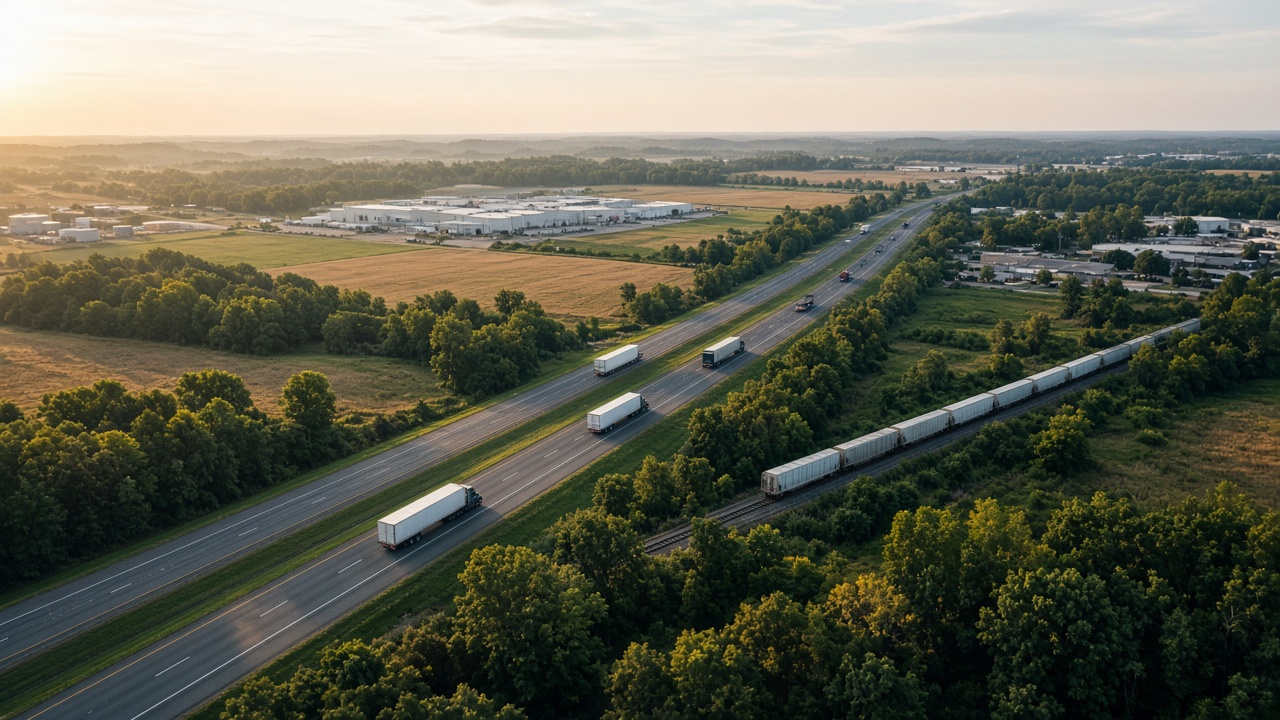
Roads, Rails, and River: Why West Tennessee Logistics Is a Community Asset
In this post, we’ll explore why West Tennessee’s logistics story—Interstate 40, rail, river access, and closeness to Memphis—matters for communities, not only for plant managers, and how civic leaders can put that story to work.
When site selectors and company teams look at a town, they don’t only ask about acreage and power. They ask a quieter question: Can we move product efficiently from here? Freight that works is how payrolls stay local, suppliers stay interested, and expansions feel realistic instead of theoretical.
Here in West Tennessee, that answer isn’t a slogan. It’s infrastructure we already live with: a coast-to-coast interstate, meaningful rail options, Mississippi River ports in the broader region, and Memphis as a logistics neighbor—not a distant brand name on a brochure. The job for mayors, chambers, and economic-development partners is to make that story clear, honest, and useful.
Why communities should care about logistics
Logistics can sound like someone else’s problem—dispatchers, carriers, warehouse managers. For a city or chamber, it’s closer to home than it seems.
Strong freight access helps:
- Recruitment — Companies comparing communities want to know how trucks, trains, barges, and air cargo fit together around your sites.
- Retention — Existing employers grow (or stay) when they can ship in parts and ship out finished goods without heroic workarounds.
- Main-street health — Industrial jobs support retail, housing, schools, and the tax base chambers care about every day.
- Regional credibility — When your community can explain its place on I-40, on a rail line, or relative to Memphis and the river, you sound like a partner who did the homework.
You don’t need to become a transportation consultant. You do need to treat roads, rails, and river access as community assets—the same way you’d talk about a hospital, a community college, or a certified industrial site.
The West Tennessee logistics picture (in plain language)
Interstate 40 — the east–west spine
I-40 runs through our region as a major east–west freight corridor. For many West Tennessee communities, “how far to I-40?” is one of the first practical questions in a site conversation. Pair that with other highways that feed north–south and regional distribution, and you have a story about connectivity—not just a pin on a map.
When you brief a prospect (or a city council), keep it concrete: nearest interstate interchange, drive time to major markets you’re comfortable verifying, and any local road projects that improve industrial access. Vague “great location” language loses to a clear, local fact sheet.
Rail — options that matter for the right projects
West Tennessee sits in a part of the country where Class I rail carriers and short lines still shape which projects make sense. Some sites are rail-served or rail-adjacent; others are a short haul from a working line. Memphis, as a regional hub, is one of the relatively few U.S. places where multiple Class I railroads come together—and that network radiates into the wider Mid-South.
For civic messaging, the win is honesty: name the carrier(s) relevant to your parks and sites, note whether a spur exists or is feasible, and don’t oversell rail if the real pitch is truck access to I-40. Site selectors respect clarity.
River — the Mississippi as a regional advantage
The Mississippi River remains a working freight artery. In our broader geography, assets like the International Port of Memphis and the Port of Cates Landing give communities a way to talk about bulk cargo, intermodal options, and long-haul water routes between the Upper Midwest and the Gulf—without inventing a port in every county.
If your community is river-adjacent or a reasonable truck haul from a port, say so with drive times and contacts you’re willing to stand behind. If you’re inland on I-40 and rail, lean into that. The region’s strength is the mix, not every mode on every parcel.
Memphis proximity — a neighbor, not a competitor by default
Memphis brings air cargo (including FedEx’s Express World Hub), deep trucking and intermodal capacity, and that multi-railroad footprint. For West Tennessee towns, proximity to Memphis is often a feature: access to a major logistics metro while offering land, workforce, and community character that a downtown Memphis site may not.
Chambers and mayors can frame it that way—close enough to plug into a global cargo hub, distinct enough to offer a different cost and quality-of-life story. Collaboration beats rivalry when the prospect’s real question is “Can we serve our customers from here?”
How to talk about it (recruitment language that works)
When a prospect, consultant, or state partner asks about logistics, try a short, civically useful script:
- Lead with your best verified mode. “We’re X miles from I-40 at [interchange]…” beats three buzzwords.
- Name the network, not the hype. Rail carrier, nearest airport for cargo or business travel, port if it’s part of your pitch.
- Connect logistics to sites. Tie the story to specific parks, buildings, or certified sites your community is actually marketing.
- Mention partners. Utilities, local ED staff, chamber, WTIA, TNECD, TVA—whoever helps assemble a clean RFI response.
- Stay in your lane on numbers. Drive times and distances you’re ready to source beat national rankings you can’t defend in a follow-up call.
A one-page “transportation & logistics” sheet for your priority sites—highway, rail, air, water, and Memphis/Jackson/Nashville orientation—is often enough. That’s the same discipline we encourage in community RFI packets: verified local facts, not brochure poetry.
What chambers and cities can do
You don’t need a new department to make logistics a civic strength. Practical moves:
- Update the basics. Keep industrial-park maps, interchange names, rail notes, and airport/port distances current in TNECD/TVA databases and on local websites.
- Walk the story once a year. Mayor, chamber, ED staff, and utility partners—same talking points so prospects don’t hear three different versions of “how close is I-40?”
- Protect industrial access. Zoning, last-mile road condition, and truck routing aren’t glamorous; they are why a logistics pitch survives the site visit.
- Invite the right allies into the room. A short conversation with a railroad economic-development contact, a port authority, or a regional airport manager can sharpen what you should (and shouldn’t) claim.
- Bundle logistics with workforce and sites. Prospects buy a community package. Freight without people or pad-ready land is only half a sentence.
- Use regional tools. Foreign-Trade Zone #283 coverage across much of West Tennessee, site-and-building support, and coordinated RFI help are part of how we compete as a region—not only as isolated towns.
The West Tennessee angle
Our region’s industrial story has always been about making and moving things. I-40, rail, river access, and Memphis proximity are why that story still holds when companies compare the Southeast. Civic leaders who can explain those assets calmly—and back them with local detail—help put West Tennessee on shortlists and keep employers who are already here.
That work belongs as much to the chamber luncheon and the city workshop as it does to the plant conference room. Logistics is infrastructure. Infrastructure is a community choice to understand, maintain, and market well.
Bottom line
West Tennessee’s logistics advantage isn’t one highway exit or one port logo. It’s the combination: interstate reach, rail options, river freight in the wider region, and a world-class cargo neighbor in Memphis. Communities that treat that combination as a shared asset—and can describe it in plain language—are better prepared for recruitment and for the expansions that grow local jobs.
If your city or chamber wants help sharpening a logistics one-pager, tying freight access to available sites, or folding transportation into an RFI response, we’re glad to think it through with you.
Please contact WTIA if you have questions about positioning West Tennessee logistics for community recruitment or want a hand connecting the dots for your next prospect conversation.
